
Return-to-Work Program · For employers
Back on the job the same week, not the same quarter.
Every ICA visit ends with written restrictions and a call to you. We build the modified-duty plan with your supervisor, recheck on a schedule, and release to full duty when the work is safe — with a functional capacity evaluation when it is not obvious.
Are you the one who got hurt? Start here.Lost-time estimator
What does a claim cost when the worker stays home?
Move the sliders for one injured employee. Nothing you enter is stored or sent to us.
How it runs
From the first visit to full duty
- 1
Evaluation and written restrictions
Day 0The worker is seen by a physician or PA the day of the injury. The work-status note lists exact limits: lift weight, push/pull, posture, hours, one-handed use. Vague notes are a leading reason modified duty fails, so we do not write them.
- 2
We call your contact
Same dayBefore the worker is back on site, your supervisor or HR contact hears the diagnosis in plain terms, the restrictions, and the recheck date. You know what to plan for before the shift starts.
- 3
Modified-duty offer, reviewed
Day 0–1You send a written offer with tasks, hours, and pay. We check it against the restrictions and sign off, so the worker is not asked to do something the note excludes.
- 4
Rechecks and PT in-house
WeeklyRestrictions loosen as capacity returns. Physical therapy runs in our clinics, scheduled around the modified shift. Every recheck ends with an updated note and another call to you.
- 5
Full duty, or an FCE first
When readyFor heavy or safety-sensitive jobs, a functional capacity evaluation measures what the worker can actually lift, carry, and sustain before we release. The release is defensible for you, the adjuster, and the worker.
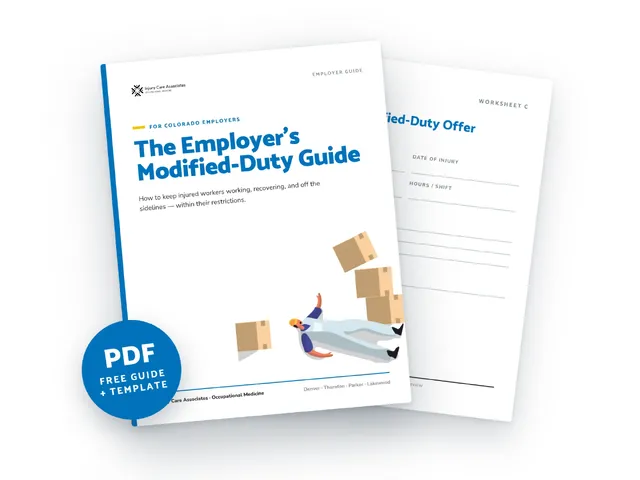
The Employer's Modified-Duty Guide, with a written offer template.
Sample tasks by industry and an offer template your supervisors can actually use.
Modified-duty matcher
“We don't have light-duty work.” You probably do.
Pick the restriction on the work-status note and your kind of operation. These are the tasks we most often see employers use.
1. The restriction
2. Your operation

If you are the one who got hurt
Modified duty is treatment, not a demotion
People who keep moving and stay connected to their crew recover faster and are far less likely to end up with a long-term problem. The restrictions we write are limits your employer must follow — not a suggestion.
- Your restrictions are the ruleIf a supervisor asks you to do something the note says you cannot, say so and call the clinic. We will talk to them.
- Your payIf modified duty pays less than your regular job, workers' compensation typically makes up part of the difference. Ask the clinic or your adjuster how it works on your claim.
- Rechecks and therapy fit your shiftWe schedule around the modified-duty hours. Physical therapy is in our clinics, and you can walk in if something changes between visits.