DOT drug and alcohol testing under 49 CFR Part 40
Certified collectors, HHS-certified labs, and MRO review for pre-employment, random, post-accident, reasonable-suspicion, return-to-duty, and follow-up tests. Clearinghouse reporting included for CDL drivers.
For employers
Stay compliant without running the program yourself
Random-pool management, consortium enrollment for owner-operators, DER training, and results delivered to your safety manager in a format ready for audit.
What is tested
The federal 5-panel, plus alcohol when required
Every DOT test screens for the same five drug classes, regardless of employer or mode. Cutoff levels are set by HHS, and any presumptive positive is confirmed by GC/MS or LC/MS before it reaches the Medical Review Officer.
Alcohol testing is required for post-accident, reasonable-suspicion, return-to-duty, and follow-up tests, and for random selection in most modes.
- FMCSA (CDL drivers)
- FTA and FRA
- FAA and PHMSA
- Owner-operators in a consortium
Marijuana
THC metabolite (THCA). Colorado legalization does not apply to DOT-regulated positions.
Cocaine
Benzoylecgonine metabolite.
Amphetamines
Amphetamine, methamphetamine, MDMA, MDA.
Opioids
Codeine, morphine, heroin (6-AM), hydrocodone, hydromorphone, oxycodone, oxymorphone.
Phencyclidine
PCP.
Alcohol
Breath test; 0.02–0.039 removes from duty 24 hours, 0.04+ is a violation.
Prescribed medication that shows up on the panel is reviewed confidentially by the MRO, who verifies the prescription before any result is reported to the employer.
How it works
From order to verified result
Chain of custody on the federal CCF at every step.
Employer orders
The DER sends an authorization or the employee arrives with the paper or electronic CCF from the consortium.
Collection
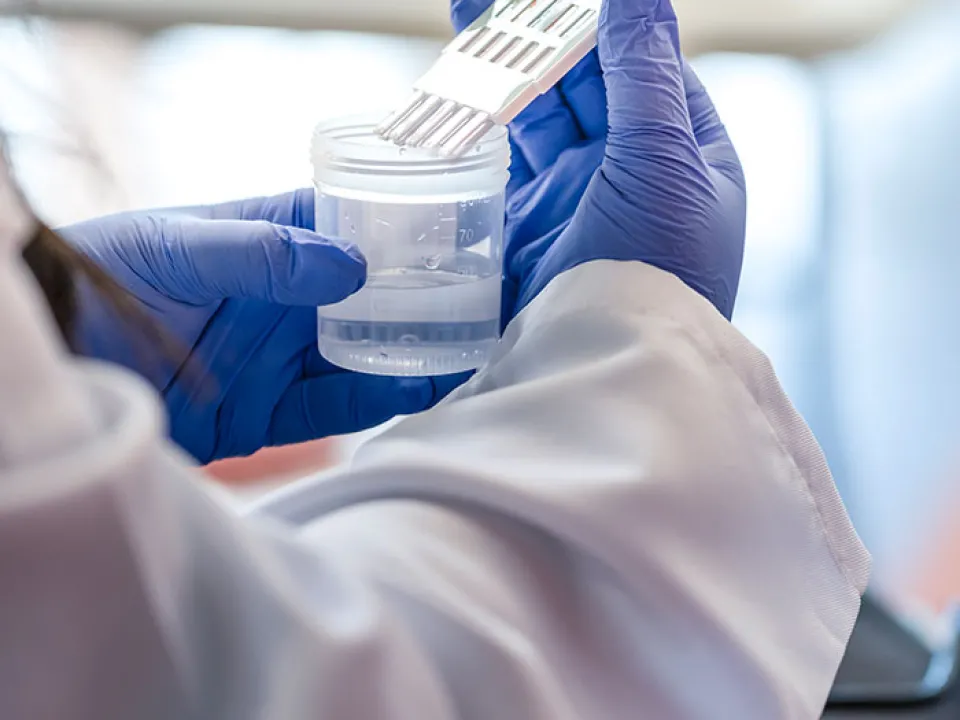
ID check, secured restroom, temperature check, split into A and B bottles, sealed and signed in front of the donor.
Lab analysis
Immunoassay screen at an HHS-certified lab; any presumptive positive is confirmed by mass spectrometry.
MRO review
Negatives release immediately. Non-negatives go to the MRO, who contacts the donor before verifying.
Before you come in
What to bring and how to prepare
A collection cannot start without ID and a valid authorization, and a driver who leaves mid-collection is recorded as a refusal.
Good to know
- Drink normally; do not overload on water, dilute specimens trigger a recollection.
- Plan for up to 3 hours if you cannot provide 45 mL on the first try.
- Do not leave the collection site once the process has started.
Bring
- Government photo ID (employer ID accepted with photo)
- Employer authorization or the CCF from your consortium
- Your CDL, for Clearinghouse reporting
- A list of current prescriptions, for the MRO if asked
Results
Who sees what, and when
DOT results move on a fixed path: lab to MRO, MRO to the employer’s Designated Employer Representative. The clinic never releases a drug result directly to a driver or supervisor.
Employee
From the MRO
- A call from the MRO before any non-negative is verified
- Right to request Bottle B testing within 72 hours
- Copy of the CCF (Copy 5) at collection
Employer (DER)
Verified results only
- Negative / positive / refusal / cancelled
- Alcohol results same visit
- No prescription or diagnosis detail
FMCSA Clearinghouse
Within 2 business days
- Verified positives and refusals for CDL drivers
- Return-to-duty and follow-up test completion
- Reported by the MRO and employer as required
Common questions
DOT drug testing, answered
Answers from our collectors and clinicians. General information, not medical or legal advice.
Do I need an appointment?
No. Walk in Monday–Friday, 7 a.m.–5 p.m. Random and post-accident tests must be completed promptly, so come as soon as you are notified. Booking guarantees a time if you are between routes.
How soon after an accident must the test happen?
Alcohol within 2 hours (8 hours at the latest); drugs within 32 hours. If the deadline is missed, the employer documents why and the test is not performed.
Can I test positive from CBD or legal marijuana?
Yes. Many CBD products contain enough THC to produce a positive, and the MRO cannot accept state legalization or a medical card as a legitimate explanation for a DOT test.
What counts as a refusal?
Not showing up, leaving before the collection is complete, failing to provide a specimen without a valid medical reason, or tampering. A refusal is treated the same as a positive.
What happens after a positive?
The driver is removed from safety-sensitive duty and referred to a Substance Abuse Professional. Return-to-duty requires a negative directly observed test and a follow-up schedule of at least 6 tests in 12 months.
Need a DOT collection today?
Monday–Friday, 7am to 5pm at Denver, Lakewood, Parker, and Thornton. Hablamos Español.
- Denver(303) 531-4144
- Lakewood(720) 689-9655
- Parker720-409-0007
- Thornton720-531-8377