Post-incident testing, collected at your site
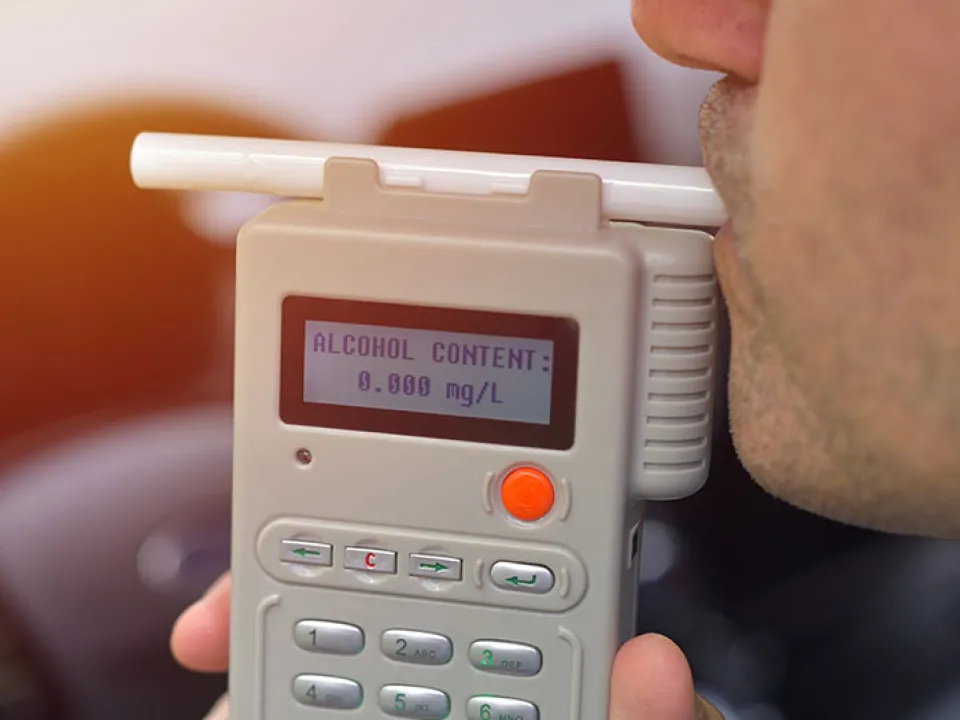
A certified collector comes to you after an accident with breath alcohol and chain-of-custody urine collection, so the test happens inside the window the policy or the regulation sets instead of after it has closed.
For employers
Set it up before the accident, not during one
Accounts are opened in advance: your panel, your DER, your authorization rules and your post-accident policy on file — so the call after an incident is one call, not a negotiation.
What the collector brings
A full collection, done properly, in your break room
A post-accident test is decided by the clock. Every hour between the incident and the collection weakens the result, and the DOT windows close whether or not a collector was available. Sending people to a clinic costs exactly the time the test does not have.
So the collector comes to you. Same chain of custody, same certified collector, same laboratory and the same review as a collection done at the clinic — at your site, while the scene is still fresh.
- DOT-regulated employers
- Construction and industrial sites
- Sites where driving an employee out would cost the window
- Employers with a written post-accident policy
Evidential breath alcohol testing
Screening and confirmation on an evidential device, by a trained breath alcohol technician.
Urine collection under chain of custody
Full custody-and-control documentation from collection to laboratory, executed on site.
Your account’s post-accident panel
Commonly a 10-panel with breath alcohol, but the panel we run is the one stored under your account.
The federal CCF, for DOT tests
DOT collections run on the federal chain-of-custody form under 49 CFR Part 40, straight to a laboratory.
Reasonable-suspicion documentation
Where the test is suspicion-based, the supervisor’s observations are documented alongside the collection.
Refusal and shy-bladder handling
The procedure that follows an inability to provide, so a refusal determination is made correctly and not by default.
Collection is all this service is. Anyone injured is treated first, by emergency services or by our injury care team as the situation requires — that is a separate service and the test waits for it.
How it works
From the call to the verified result
Chain of custody is maintained at every step, on site as in the clinic.
Care first, then the call
Injuries are treated before anything else. Once the scene is safe, your DER calls and authorizes the test, and a collector is dispatched on that call.
Collection on site
Breath alcohol first where it applies, then the urine collection under full chain of custody.
Screen, laboratory and MRO
Where your protocol allows a rapid screen, negatives read the same day. Anything non-negative goes to a certified laboratory and to the MRO.
Result to the DER
The verified result goes to your designated employer representative, and to nobody else at the company.
Before you come in
Before the collector arrives
Nothing on this page is medical care. If anyone is hurt, treat that first and call the test in second — the collection is designed to fit around it.
At the scene
- Keep the employee at the site and supervised until the collector arrives; leaving can itself be treated as a refusal under some policies.
- Have the supervisor write down what they observed while it is fresh, especially for a reasonable-suspicion test.
- Do not let the employee wash up, eat or drink beyond what is needed for their safety before the collection.
Have ready
- Photo ID for the employee being tested
- The DER’s authorization for the test
- The incident report or the supervisor’s written observations
- A private space with a washroom for the collection
Results
Who is told what, and in what order
A post-accident result travels a fixed route: laboratory to medical review officer, medical review officer to your designated employer representative. No supervisor at the scene is told a result, and the collector does not have one to give — that separation is what makes the result usable later.
Employee
At collection, then from the MRO
- A copy of the chain-of-custody form at the collection
- A call from the medical review officer before any non-negative is verified
- The chance to explain a prescription, confidentially, to the MRO and not to the employer
Employer (DER)
On verification
- A verified result, not a raw laboratory value
- Rapid-screen negatives the same day where the protocol allows a rapid screen
- A refusal determination where one applies, with the basis documented
Incident record
Retained
- The custody-and-control form and the collection record
- Supervisor observations where the test was suspicion-based
- Available if the claim or the test is challenged
Common questions
Post-incident testing, answered
Answers from our collectors and clinicians. General information, not medical or legal advice.
How long do we have?
For DOT tests the windows are set by regulation: alcohol within two hours, eight at the latest, and drugs within thirty-two hours. Miss one and the employer has to document why. A non-DOT policy sets its own window, and the sooner the collection happens the better the result stands up. If an incident happens outside business hours, the alcohol window is the one at risk — call us as early as you can the next morning, and document the delay either way. General information, not legal advice.
Someone is injured. Do we wait?
Treat the injury first, always. Medical care is not this service and never waits on a collection. Call the test in once the scene is safe — tell us an injury is involved and we will work around the care.
What counts as a refusal?
Leaving the site before the collection, refusing to provide a specimen, or failing to provide one without a documented medical explanation. Shy bladder has its own procedure, and we follow it rather than calling a refusal by default — a refusal determination made carelessly is the one most likely to be overturned.
Can we test on site if we are not DOT-regulated?
Yes. On-site collection is available to employer accounts generally. Your own policy sets the panel and the window; we run what is stored under your account.
Do you come out, or do we come in?
Either. On-site collection is dispatched on your call during business hours, anywhere in the Denver metro. Outside those hours or outside the metro, collection happens at Denver, Thornton, Parker or Lakewood — and for an incident near a clinic, driving in is often the faster route anyway.
Set up post-incident testing before you need it
Monday–Friday, 7am to 5pm at Denver, Lakewood, Parker, and Thornton. Hablamos Español.
- Denver(303) 531-4144
- Lakewood(720) 689-9655
- Parker720-409-0007
- Thornton720-531-8377