Onsite servicesInjury & incident response
Job site first aid & injury evaluation
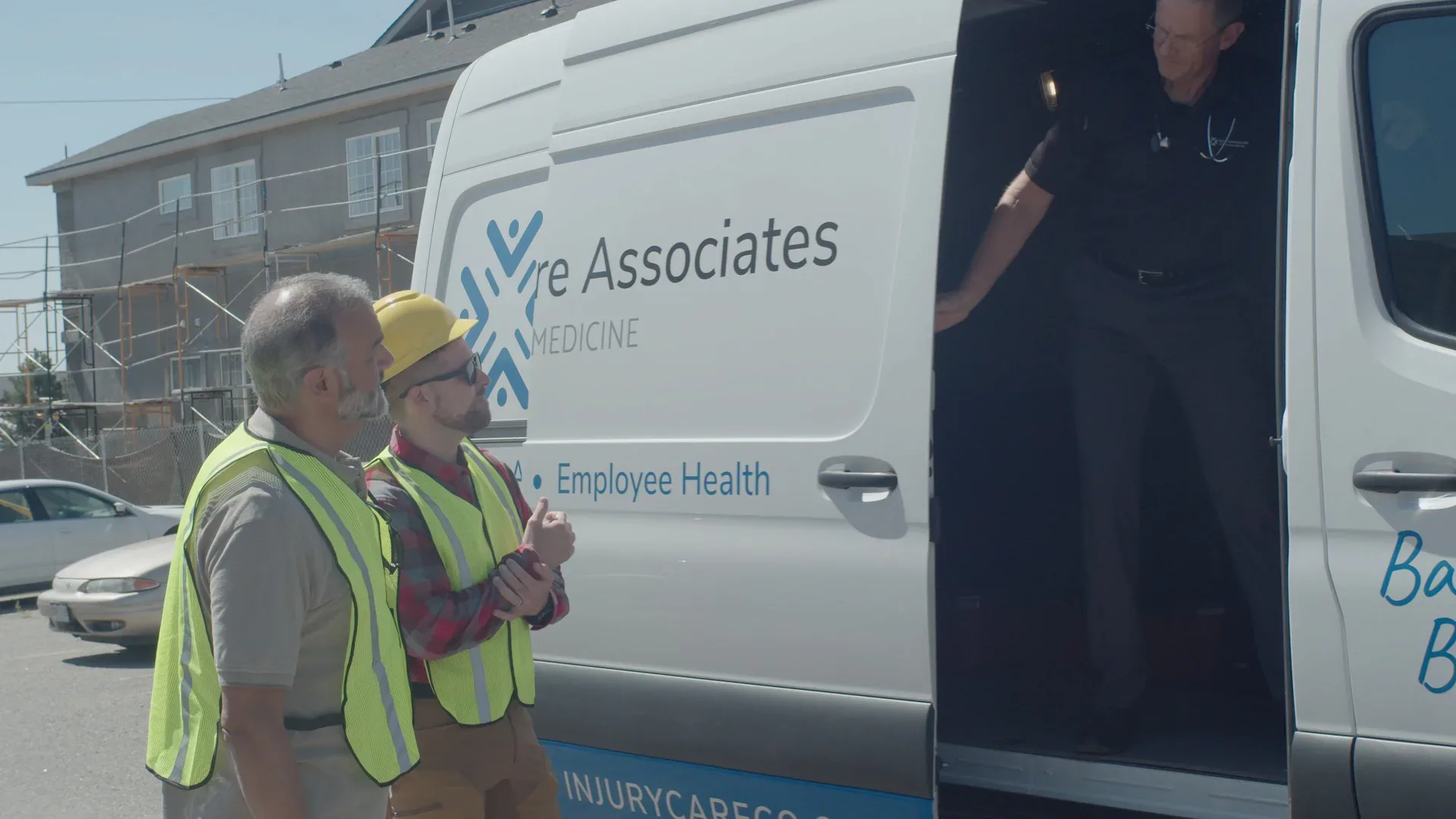
When someone gets hurt, call us first. An ICA Registered Nurse comes to your site, evaluates the injury, and treats what can be treated on the spot — so your crew stays on the job and the incident is handled correctly from minute one.
- 2-hour response target
- Registered Nurse on site
- Same-day written evaluation
How a call goes
From injury to documented outcome
One number, one process, every time. Your supervisors don’t have to decide whether an injury is “clinic worthy” — that’s our job. Step through it below.
One number, every injury
However minor it looks. A nurse takes the call and gathers what happened, to whom, and how — before anyone makes a decision about care.
Your team does
Call the triage line and stay with the injured employee.
ICA does
A Registered Nurse documents the mechanism of injury and asks the screening questions.
We decide the level of care
Self-care, an on-site response, a clinic visit, or a 911 situation. We say which one, clearly, and we own the call — your supervisor is not practicing medicine.
Your team does
Answer a short set of questions about the injury.
ICA does
Nurse triage with physician backup determines the right level of care.
Care comes to the job site
A Registered Nurse arrives with first-aid supplies, examines the employee where they work, and treats what is treatable in the field.
Your team does
Point the nurse to the employee and the incident location.
ICA does
Hands-on exam, first-aid treatment, and a work-status recommendation.
Documented the same day
Findings, treatment, work status, and restrictions are written up and sent to your designated contact — ready for your carrier, your adjuster, and your OSHA log.
Your team does
Nothing. It lands in your inbox.
ICA does
Same-day written evaluation with restrictions and follow-up plan.
Scope of care
What we handle at the job site
Our nurses carry the supplies to treat the injuries that actually happen on job sites. Anything beyond first aid gets evaluated, stabilized, and routed to the right level of care.
Wounds and skin
The most common call we get, and the most avoidable clinic trip.
- Laceration cleaning and closure strips
- Abrasions and puncture wounds
- Minor burns and thermal injuries
- Splinter and foreign-body removal
- Dressing changes and wound checks
Musculoskeletal
Strains and overexertion drive the majority of lost-time claims.
- Strain and sprain assessment
- Range-of-motion evaluation
- Splinting and immobilization
- Ice, wrap, and support application
- Lifting and overexertion injuries
Eyes, head and airway
Time-sensitive assessments where a fast, correct call matters most.
- Eye irrigation and foreign-body removal
- Concussion and head-injury screening
- Respiratory and inhalation assessment
- Neurological status checks
Incident follow-through
The work after the treatment that keeps the claim clean.
- Post-accident drug and alcohol testing
- Vitals and baseline documentation
- Work status and restriction guidance
- Coordination with your clinic visit
- Return check-ins on healing injuries
In an emergency — loss of consciousness, uncontrolled bleeding, suspected spinal injury, chest pain — call 911 immediately. On-site first aid is not a substitute for emergency services.
The evaluation
A real clinical decision, not a guess
Every on-site response includes a documented injury evaluation: mechanism of injury, exam findings, treatment given, and a recommendation. Our nurses work under physician oversight and can put a provider on the phone during the visit.
That evaluation is what determines whether the employee returns to work, goes to one of our clinics, or is sent for emergency care — and it’s the record your claim rests on.
Treated and back to work
First-aid level care delivered on site, restrictions documented if any, employee finishes the shift.
Routed to an ICA clinic
Needs provider-level care, prescription treatment, or an imaging referral. We schedule the visit and arrange free transportation from the job site.
Emergency escalation
Stabilize and call 911. We notify your contact and follow the case through the hospital handoff.
OSHA sensitivity
First aid and recordable care are not the same thing
OSHA draws a specific line between first aid and medical treatment beyond first aid. Care that stays on the first-aid side of that line — and is documented as such — does not become a recordable case on that basis.
Our nurses know where that line sits. We never withhold care an employee needs, but we also don’t create a recordable out of a splinter because the nearest urgent care reaches for a prescription.
- Cleaning and dressing a surface woundFirst aid
- Using wound closure strips or butterfly bandagesFirst aid
- Non-rigid support — elastic wrap, slingFirst aid
- Eye irrigation and foreign-body removal with a swabFirst aid
- Sutures, staples, or prescription medicationRecordable
- Rigid splint or cast to immobilize an injury (not just for transport)Recordable
Illustrative examples. Recordability depends on the specific case and the treatment actually given, under 29 CFR 1904.7; the employer makes the recording decision.
Why employers use it
What changes on the ground
0
Trips off site
Minor injuries no longer cost you half a shift of travel and waiting-room time for the employee and whoever drove them.
1
Number to call
Supervisors stop making medical judgment calls. Every injury goes through the same triage line and the same process.
2 hr
Response target
Care reaches the employee while the incident is fresh — better outcomes, and a cleaner record of what happened.
Same day
Documentation
Written evaluation and work status in your hands the same day, ready for your carrier and your OSHA log.
Common questions
Questions safety managers ask
Don’t see yours? Get in touch and we’ll walk through how this would work on your sites.
Watch the video See ICA on-site care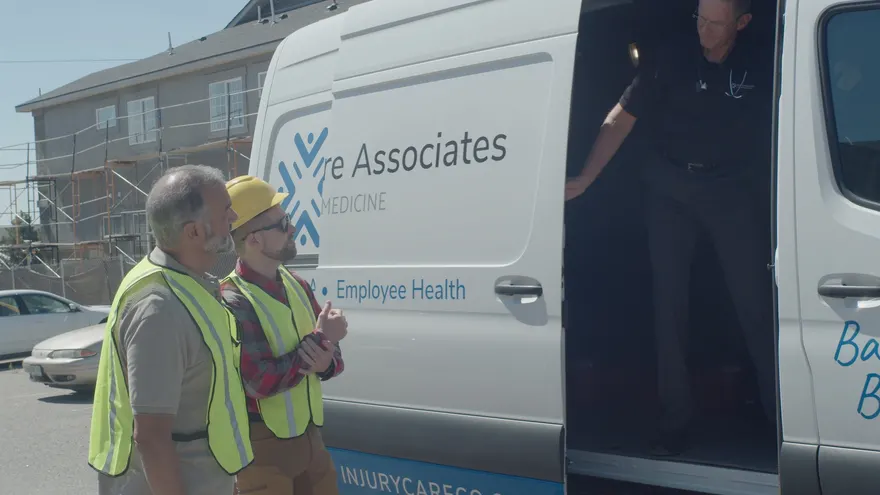
A Registered Nurse from ICA’s on-site team. Our nurses work under the oversight of our occupational medicine physicians, who are reachable by phone during the visit.
Our target is two hours for Denver-metro job sites. The triage line is answered 6 a.m.–11 p.m., seven days a week. The 2-hour response is a target, not a guarantee: response times for your locations are confirmed when your plan is set up, and the nurse gives you a realistic ETA on every call.
The nurse stabilizes the employee and routes them to the right place — one of our four clinics for same-day provider care, or emergency services if the situation calls for it. For a clinic visit we also arrange transportation between the job site and the clinic, at no cost to the employee or to you.
Not by itself. Recordability depends on the treatment provided, not on where it happens or who provides it. Care that meets OSHA’s definition of first aid does not make a case recordable, and our documentation states exactly what was done so your log is defensible.
A same-day written evaluation covering mechanism of injury, findings, treatment provided, work status, and any restrictions — sent to your designated contact and available to your carrier and adjuster.
On-site injury response is included in both the On-Site Health and Enterprise subscription plans, which guarantee availability and priority response. Services are billed per our standard fee schedule on top of the subscription.
Get set up
Have a number your crews can call
Tell us where your sites are and how your crews work. We’ll map out response coverage and get your supervisors the injury-response card to post.