Key takeaway: Work conditioning is the bridge between "medically healed" and "ready for full duty." It's a structured, intensive exercise program — typically a few hours a day, several days a week, over multiple weeks — that rebuilds the specific strength, endurance, and movement tolerance your job demands. It is not more physical therapy; it's the next stage after PT has done its job.
This guide is for injured workers who've been referred to work conditioning, and for employers wondering what their employee is doing for those weeks.
Where Work Conditioning Fits in Recovery
Picture recovery in stages: acute care treats the injury; [LINK: physical therapy] restores basic motion, strength, and function; work conditioning restores work capacity — the ability to lift, carry, push, climb, and keep doing it for a full shift. A warehouse worker can finish PT able to lift 20 pounds comfortably, and still be nowhere near safely handling 50-pound cases for eight hours. That gap is exactly what work conditioning closes.
Work Conditioning vs. Work Hardening vs. PT
| | Physical therapy | Work conditioning | Work hardening |
|---|
| Goal |
Restore motion, strength, function |
Rebuild physical capacity for the job |
Full simulation of job demands |
| Format |
Shorter sessions, clinical exercises |
A few hours/day of progressive, job-relevant exercise |
Longer days, multidisciplinary, simulated work tasks |
| Typical stage |
Early–mid recovery |
Late recovery, pre-return |
Complex or long-duration cases |
| Team |
Physical therapist |
PT/exercise professionals using your job demands |
PT plus occupational and sometimes behavioral health |
[CLINICIAN VERIFY program descriptions match ICA's actual offering]
What a Typical Week Looks Like
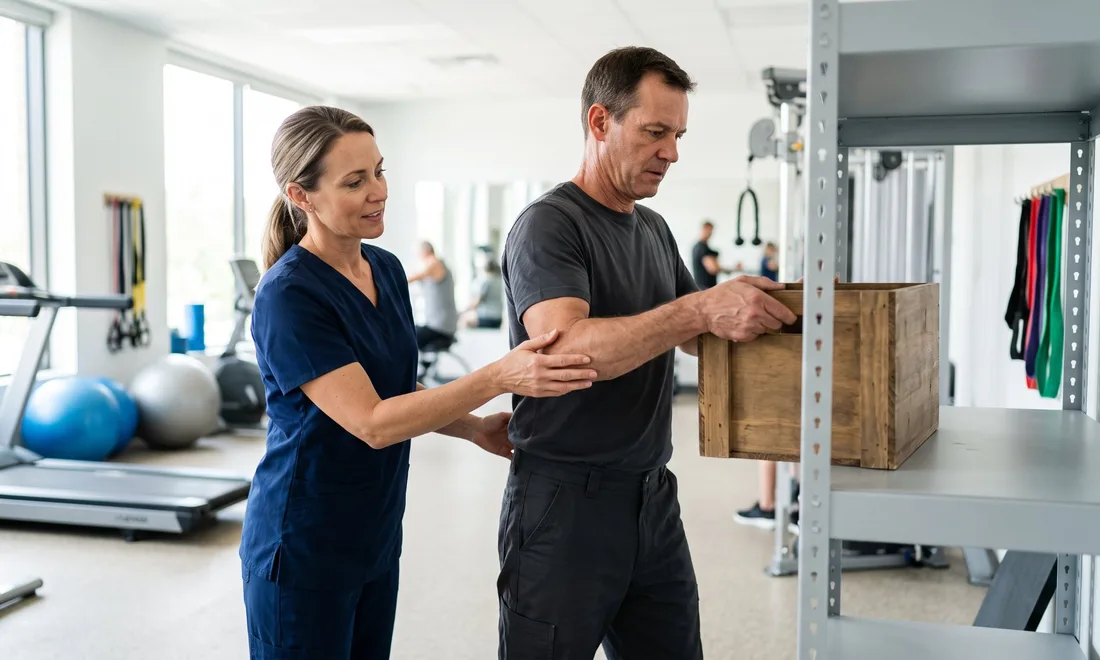
Expect a schedule, not a drop-in: commonly 3–5 sessions per week, 2–4 hours each, over roughly 2–6 weeks depending on the gap between your current capacity and your job's demands. Sessions blend progressive strengthening, cardiovascular endurance, and job-specific tasks — lifting circuits at your job's real weights and heights, carrying, pushing sleds, ladder or stair work — with loads that increase as you do. It should feel like training for your job, because it is.
You'll likely be tired. You should not be harmed — programs progress within safe limits, and clinicians adjust based on your response. Speak up about symptoms; that information steers the program.
How Progress Is Measured
Work conditioning runs on numbers, not vibes: measured lifting capacities, tolerated durations, heart-rate response, and task completion against your documented job demands. Many programs anchor to a [LINK: Functional Capacity Evaluation (FCE)] — a standardized assessment of what you can safely do — at the start, the end, or both. Those measurements are what tell your doctor, your employer, and the insurer that "ready for full duty" is a fact rather than a hope.
The Employer's Role
Modified duty and work conditioning are partners, not alternatives. Workers often continue part-time modified duty while conditioning, which keeps income flowing, skills fresh, and the return path short. Employers: providing an accurate, current job demands description is the single most useful thing you can do — the program can only train toward demands it knows about.
Common Worries, Answered Straight
"Is this just a test to cut off my benefits?" No — it's treatment, ordered as part of your care. The measurements protect you too: returning before you're ready is how re-injuries happen, and documented capacity is your evidence as much as anyone's.
"What if I can't do something?" That's data, not failure. Programs progress from where you are; plateaus get evaluated and plans adjusted.
"Will I be watched the whole time?" You'll be supervised by clinical staff — that's the point. It's coaching, not surveillance.
Where ICA Fits In
ICA's [LINK: work conditioning program] builds each plan from the worker's actual job demands and coordinates directly with the treating physician and employer, so everyone's working from the same numbers. Questions about a referral? [LINK: Contact us].
FAQ
Does workers' comp pay for work conditioning? When ordered as part of authorized treatment for a compensable injury, work conditioning is typically covered like other treatment. Confirm specifics with your adjuster.
Can I skip it and just go back to work? Returning before your capacity matches your job's demands is the classic re-injury setup — and a second injury is usually worse than the first. The weeks invested are cheaper than the relapse.
What's the difference between this and a gym membership? Supervision, progression tied to your medical case, job-specific tasks, and documentation that moves your claim forward. A gym builds fitness; work conditioning builds your return-to-work case.
General information, not medical advice. Follow your treating clinician's guidance.
[Medically reviewed by — REQUIRED] · Last reviewed: [DATE]