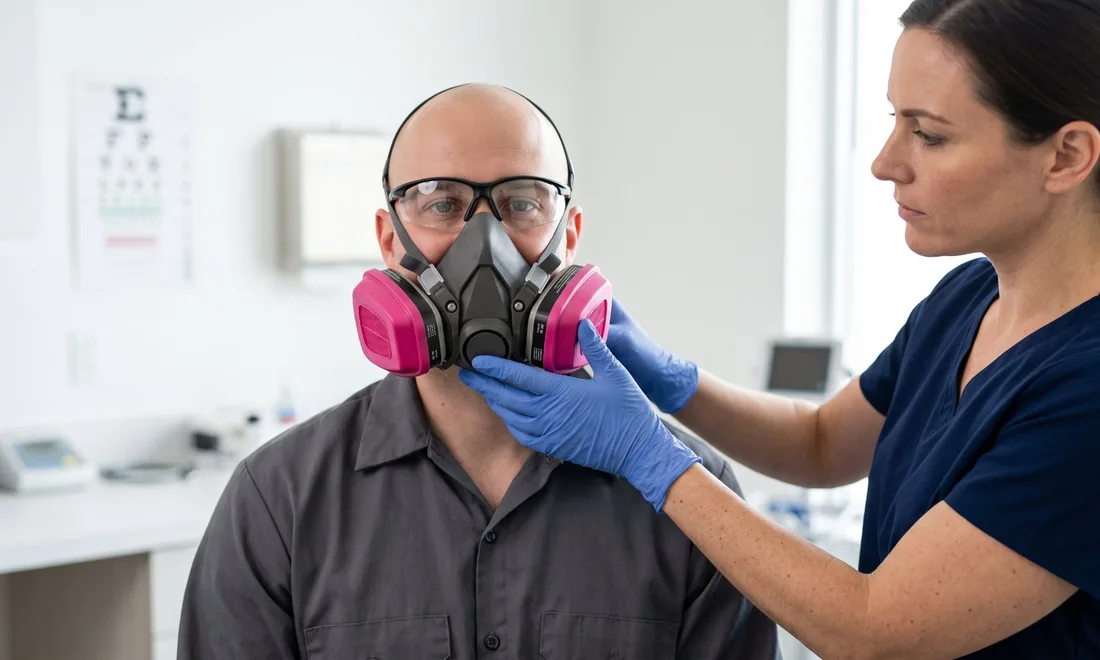
Key takeaway: If your employees wear tight-fitting respirators — N95s included — OSHA's respiratory protection standard (29 CFR 1910.134) requires a medical evaluation before first use, a fit test before first use, and a fit test at least annually after that. A respirator that hasn't been fit tested is, functionally, a costume: the seal is the protection, and the test is the only way to know the seal exists.
This guide is for safety managers and employers running (or realizing they need) a respiratory protection program — construction, manufacturing, healthcare, painting, abatement, agriculture.
What Triggers the Requirement
The standard applies whenever respirators are required to protect against airborne hazards — dusts, fumes, vapors, infectious aerosols. The program obligations include a written program, hazard assessment, medical evaluation, fit testing, training, and maintenance. Fit testing specifically applies to tight-fitting facepieces: filtering facepieces like N95s, half-face and full-face elastomerics. Loose-fitting PAPR hoods don't require fit testing (though the rest of the program still applies). [COMPLIANCE VERIFY scope summary]
Step One Isn't the Fit Test — It's the Medical Evaluation
Before anyone is fit tested or wears a required respirator, OSHA requires a medical evaluation — typically the standard questionnaire reviewed by a licensed healthcare professional, with an exam or pulmonary function testing when answers warrant it. Respirators add breathing resistance and heat load; the evaluation screens for conditions (cardiopulmonary disease, claustrophobia, some medication effects) that make that unsafe. ICA performs both the medical evaluation and the fit test in one visit, which is the efficient order of operations. [LINK: Respirator Fit Testing]
Qualitative vs. Quantitative: Two Ways to Test a Seal
| | Qualitative (QLFT) | Quantitative (QNFT) |
|---|
| How it works |
Pass/fail taste or smell challenge — saccharin or Bitrex aerosol under a hood while you move and talk |
Instrument counts particles inside vs. outside the mask and computes a fit factor |
| Allowed for |
Half-face respirators, including N95s (negative pressure, used up to 10x the exposure limit) |
Any tight-fitting respirator; required for full-face negative pressure at higher protection levels |
| Feels like |
Slightly silly: head turns, talking, bending while someone sprays bitter mist |
Same exercises, wearing a sampling probe |
| Time |
~15–20 minutes per mask model |
~15–20 minutes per mask model |
[COMPLIANCE VERIFY technical specifics]
Either way, the test is specific to the make, model, style, and size of respirator. Pass on one model, and that's the model you wear — switching brands means retesting.
When You Must Retest
At least annually — plus any time the respirator model or size changes, and whenever the wearer's face does: significant weight change, dental work, facial surgery, or scarring in the seal area. Workers should know to flag those changes; supervisors should know to ask.
Yes, the Facial Hair Rule Is Real
OSHA prohibits anything between the sealing surface and the skin — stubble, beards, and long sideburns in the seal path defeat tight-fitting respirators. Mustaches and beards that stay clear of the seal can be fine. This is the policy employees push back on most, and the answer is physics, not preference: leak paths don't negotiate. For workers whose facial hair can't change, loose-fitting PAPRs are the standard accommodation conversation. [CLINICIAN VERIFY]
Running It Onsite
For crews of any size, fit testing is a natural onsite service: medical evaluations and fit tests delivered at your facility on a scheduled cycle beats sending workers out one at a time all year. ICA offers [LINK: onsite fit testing] alongside in-clinic appointments — and can pair the annual fit test cycle with audiometric testing or other surveillance exams in the same visit.
Where ICA Fits In
Medical evaluation and fit testing in one visit, in clinic or [LINK: onsite at your facility], with documentation your written program needs. [LINK: Schedule] or ask us about setting up an annual program cycle.
FAQ
Do N95s really require fit testing? Yes — when their use is required by the employer under the standard, N95 filtering facepieces are tight-fitting respirators and require both medical evaluation and annual fit testing. Voluntary-use scenarios have lighter requirements. [COMPLIANCE VERIFY voluntary-use note]
How long does a fit test take? About 15–20 minutes per respirator model once the medical evaluation is cleared — figure under an hour for a new employee doing both steps.
What happens if someone fails? A failed test means that model doesn't seal on that face — you try a different size or model until one passes. It's a matching exercise, not a pass/fail on the person.
General information, not legal or medical advice. Your written respiratory protection program and OSHA's standard govern specifics.
[Medically reviewed by — REQUIRED] · Last reviewed: [DATE]
[INTERNAL NOTE — DO NOT PUBLISH until the duplicate respirator URLs (respirator-fit-test.html vs respirator-fit-testing.html) are consolidated; then point links at the canonical page.]