Key takeaway: Heat exhaustion and heat stroke are the two stages of serious heat illness — and the difference between them is a medical emergency. Heat stroke can be fatal; confusion, hot dry skin, or a body temperature near 104°F means call 911 immediately. Most heat-related deaths at work happen to employees in their first week on the job, which makes acclimatization the single most effective prevention tool employers have.
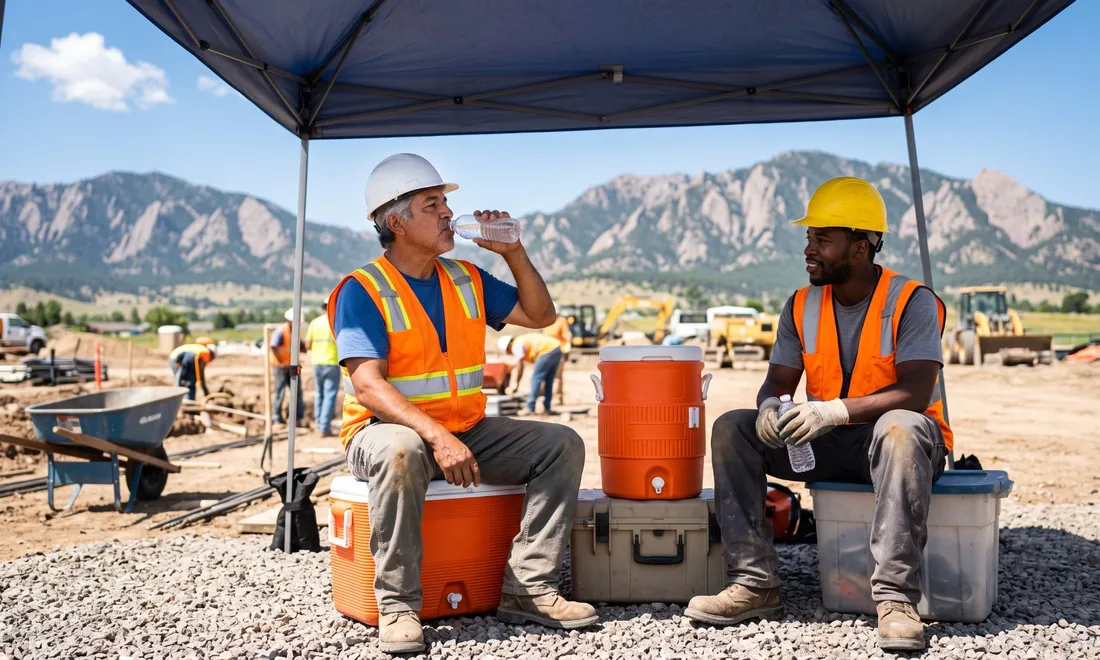
Colorado’s outdoor workers face a heat risk that surprises people who associate heat illness with Phoenix or Houston. This guide is for construction crews, road and utility workers, landscapers, agricultural workers, and the supervisors and safety managers responsible for them.
Why Colorado Heat Is Sneaky
Two things make Colorado’s climate deceptive for workers:
Altitude intensifies exposure. At 5,000+ feet, UV radiation is significantly stronger and the body works harder at any given task, raising metabolic heat production. New arrivals to Colorado face a double acclimatization burden — heat and altitude.
Low humidity hides fluid loss. In dry air, sweat evaporates almost instantly. Workers don’t feel drenched, so they underestimate how much fluid they’re losing — and dehydration arrives ahead of the warning signs people expect.
Add summer job-site temperatures that regularly exceed 90°F along the Front Range, and the risk is real even when the air “feels” comfortable.
Heat Exhaustion vs. Heat Stroke: Know the Difference
This is the table to print and post in the trailer. [POSTER VERSION AVAILABLE — link to Request Posters page]
| | Heat Exhaustion | Heat Stroke (EMERGENCY) |
|---|
| Skin |
Cool, pale, clammy, heavy sweating |
Hot, red; may be dry OR sweating |
| Mental state |
Tired, dizzy, irritable |
Confused, slurred speech, seizures, loss of consciousness |
| Body temp |
Elevated but below 104°F |
At or above ~104°F (40°C) |
| Other signs |
Headache, nausea, weakness, muscle cramps, fast weak pulse |
Fast strong pulse, throbbing headache, vomiting |
| Response |
Move to shade, cool, hydrate, monitor |
Call 911. Cool aggressively. Do not leave alone. |
The dangerous transition is mental status. A worker who was sweaty and tired an hour ago and is now confused or stumbling is not “pushing through it” — they are in a life-threatening emergency.
First Aid: What to Do on Site
For heat exhaustion: 1. Move the worker to shade or air conditioning immediately. 2. Loosen clothing; apply cool, wet cloths to head, neck, armpits, and groin. 3. Sip water — no chugging, no energy drinks, no alcohol. 4. Monitor for 15–30 minutes. If symptoms worsen or don’t improve, get medical care. 5. Do not send them back to work the same shift without a medical evaluation.
For suspected heat stroke: 1. Call 911 first. Minutes matter. 2. Cool aggressively while waiting: ice packs to neck/armpits/groin, soak clothing, fan continuously. If safe immersion is possible (stock tank, kiddie pool), use it. 3. Do not give fluids to a confused or unconscious person. 4. Never leave them alone.
Prevention: What Actually Works
Acclimatize new and returning workers. OSHA’s data shows most worker heat fatalities occur during the first week on the job. NIOSH recommends new workers start at about 20% of a normal heat-exposure workload on day one, increasing roughly 20% per day. Workers returning from a week or more away need a shortened re-acclimatization ramp. This single policy prevents more heat deaths than any other measure.
Water, rest, shade — on a schedule, not on request. OSHA recommends about 8 ounces (one cup) of water every 15–20 minutes during heavy work in heat — roughly a quart per hour. Make breaks mandatory and supervisor-enforced; workers chasing production goals skip voluntary ones.
Use the heat index, not the thermometer. Plan protective measures when the heat index passes 80°F and escalate them above 90°F. Schedule the heaviest tasks before 10 a.m. when possible.
Build a buddy system. The person who spots heat stroke is almost never the victim — confusion erases self-awareness. Pair workers and train them to watch each other.
Train supervisors to respond, not improvise. Every crew lead should know the symptom table above and the 911 threshold cold.
Where ICA Fits In
If a worker shows heat illness symptoms that improve with first aid but you want a same-day medical evaluation before returning them to duty, that’s exactly what an occupational health clinic is for — including documentation that protects both the worker and your OSHA recordkeeping. ICA also delivers onsite job-site first aid and evaluation services and can help you build a written heat illness prevention plan as part of an injury prevention program.
FAQ
Is heat illness a recordable OSHA injury? It can be. Heat illness requiring medical treatment beyond first aid, or causing days away from work, is generally recordable. Heat stroke cases involving hospitalization must be reported to OSHA within 24 hours. When in doubt, get a medical evaluation and document everything. [CLINICIAN/COMPLIANCE VERIFY]
Can a worker refuse to work in extreme heat in Colorado? Workers have the right to raise safety concerns, and employers have a general duty under OSHA to protect workers from recognized hazards, including heat. The practical answer: a written heat plan with trigger temperatures removes the ambiguity for everyone.
How long does heat acclimatization take? Most workers acclimatize substantially within 1–2 weeks of gradually increasing exposure. The adaptation fades quickly — about a week away from heat work means ramping back up rather than resuming full intensity on day one.
This article is for general information and isn’t a substitute for medical care. If a worker shows signs of heat stroke, call 911 immediately.
[Medically reviewed by — REQUIRED] · Last reviewed: [DATE]