Key takeaway: When employee noise exposure reaches an 8-hour average of 85 decibels — roughly the level where you must raise your voice at arm's length — OSHA's general-industry standard requires a hearing conservation program: exposure monitoring, a baseline audiogram within 6 months of first exposure, annual audiograms compared against that baseline, hearing protection, and yearly training. Noise-induced hearing loss is permanent, painless while it happens, and entirely preventable — which is exactly the profile of a hazard that gets ignored until the audiograms say it's too late. [COMPLIANCE VERIFY citations: 29 CFR 1910.95; construction differs]
This guide is for Colorado manufacturers, shops, and industrial employers — and anyone whose floor requires shouting.
The Two Numbers That Matter
- 85 dBA (8-hour TWA) — the action level: hearing conservation program required; hearing protection must be made available to all exposed employees
- 90 dBA (8-hour TWA) — the permissible exposure limit: feasible engineering and administrative controls required, with hearing protection mandatory in the meantime
The everyday translation: grinders, routers, pneumatic tools, unmuffled engines, and busy production floors routinely live in this range. If conversation at three feet takes effort, measure — guessing is not a monitoring program. [COMPLIANCE VERIFY]
The Program, Piece by Piece
1. Noise monitoring. Representative measurements identifying who's at or above 85 dBA TWA; re-monitor when processes, equipment, or controls change. Affected employees get to observe and see results.
2. Baseline audiogram — the clock starts at hire. Within 6 months of first exposure at the action level (up to one year when using mobile test vans, with interim hearing protection). Critical detail: the baseline requires 14 hours without workplace noise beforehand — or hearing protection standing in for quiet — so schedule baselines before shifts, not after them. Bundle the baseline into [LINK: pre-placement screening] for noise-exposed roles and the timing handles itself. [CLINICIAN VERIFY]
3. Annual audiograms, compared to baseline. The comparison hunts for a standard threshold shift (STS) — an average 10 dB or greater worsening at 2000, 3000, and 4000 Hz in either ear. An STS triggers a defined response: employee notification in writing within 21 days, refitting/retraining on protection, mandatory protection if not already required, and clinical referral where indicated. Certain shifts also become OSHA recordable hearing-loss cases when the loss crosses the recordability criteria — coordinate the audiologist's review with your [LINK: 300-log process]. [COMPLIANCE VERIFY STS and recordability details]
4. Hearing protection that actually protects. Variety matters (plugs and muffs, sized options), attenuation must be adequate for the measured exposure, and fit/use training is annual. The best-rated plug worn loosely is theater.
5. Annual training and records. Effects of noise, purpose and fitting of protectors, purpose of audiometric testing. Keep exposure measurements and audiometric records per retention rules.
Run It Onsite or Lose the Days
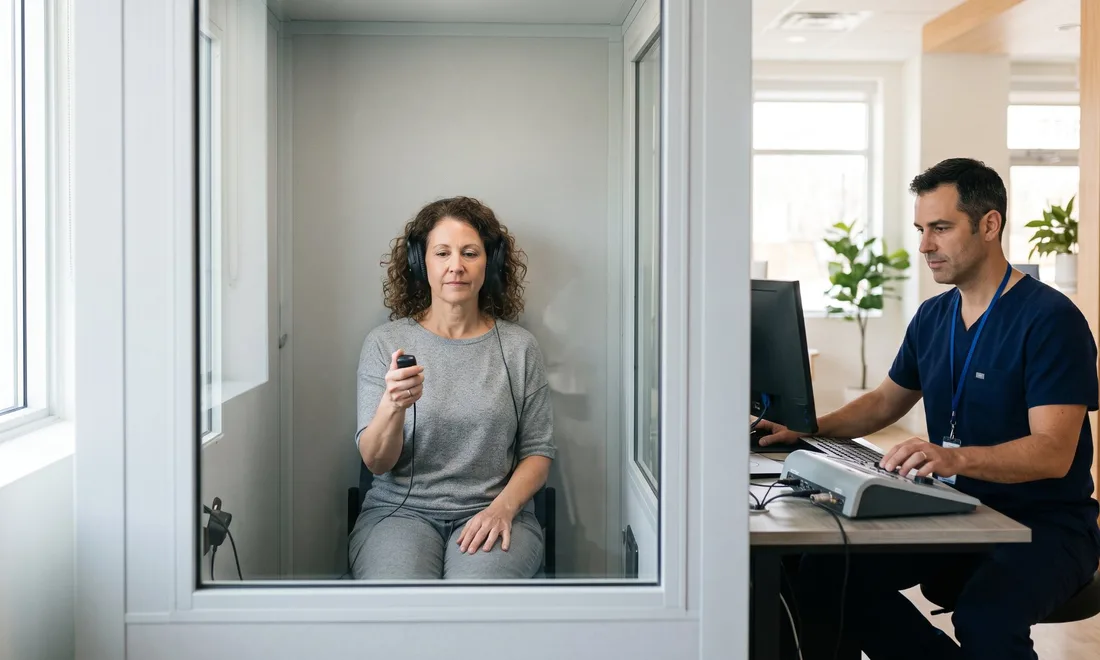
The logistics are where programs decay: an annual audiogram per exposed employee, each requiring travel and the quiet-period choreography, quietly eats production days all year. Onsite audiometric testing — a mobile booth at your facility on a scheduled day — converts the whole roster into hours, handles the comparison and notification workflow in one pass, and stacks neatly with [LINK: respirator fit testing] and other annual services into a single compliance day. [VERIFY ICA onsite audiometric capability and booth standards]
The Part the Standard Whispers: Controls Beat Earplugs
Hearing protection is the floor, not the ceiling. The exposures driving your program often have engineering fixes with real paybacks — mufflers and silencers on pneumatic exhausts, vibration isolation, enclosures around the loudest machine, barriers, maintenance on bearings and fans that scream because they're dying, and purchase specs that buy quiet equipment in the first place. Every dB engineered out shrinks the program and the risk together.
Where ICA Fits In
ICA provides baseline and annual audiometric testing — in clinic or [LINK: onsite] — with STS comparison, notification support, and the documentation your program and your 300 log both need, bundled with physicals and fit testing where that saves you days. [LINK: Contact us]
FAQ
Does construction have the same rules? Construction noise rules differ from general industry — protection and monitoring obligations exist but the hearing conservation program requirements aren't identical. Verify which standard governs your work before copying a general-industry program. [COMPLIANCE VERIFY]
Can an employee refuse the audiogram? The audiometric program is an employer obligation for covered employees; handle refusals like other mandatory-program refusals — documented, consistent policy, and a conversation about why the test protects them. [LEGAL VERIFY framing]
An employee already has hearing loss at baseline — are we liable for it? The baseline exists precisely to timestamp pre-existing loss. What the program tracks — and what you're responsible for preventing — is the shift from that baseline forward. Another reason baselines belong at hire, not whenever.
General information, not legal or medical advice.
[Medically reviewed by — REQUIRED] · Last reviewed: [DATE]